Saturn
|
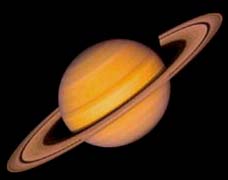
 A gas giant like Jupiter, Saturn is the least dense of all the planets, 70% as dense as water. If Saturn could be dropped into a gigantic tub of water, it would float. Saturn, like Jupiter, is mostly composed of hydrogen and helium, but is thought to have a heavy element core on the order of10 times the mass of the Earth. Saturn's ring system is visible with a small telescope. NASA's Voyager space-probes revealed that the rings number more than a thousand. Present understanding is that the rings did not form with the planet but are the remains of a shattered moon or comet, formed some 100 million years ago. The great ring is a "disk more than 180,000 miles wide but scarcely 60 ft high, making it many orders of magnitude flatter than a pancake. Ring researchers compare it to a sheet of tissue paper spread across a football field." Sobel
|
Saturn Concepts
Solar System Illustration
Solar System Concepts
| HyperPhysics********** Astrophysics | R Nave |
 Graphic from