Cygnus X-1
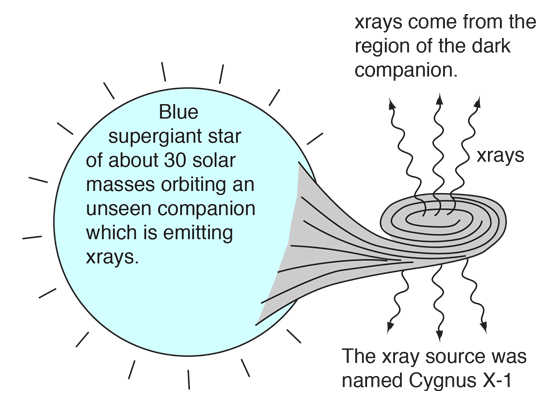
Doppler studies of this blue supergiant in Cygnus indicate a period of 5.6 days in orbit around an unseen companion. The B-type blue supergiant (HDE226868) is projected to have a mass of about 25 solar masses. The mass of the companion is calculated to be 8-10 solar masses, much too large to be a neutron star.
1. An x-ray source was discovered in the constellation Cygnus in 1972 (Cygnus X-1). X-ray sources are candidates for black holes because matter streaming into black holes will be ionized and greatly accelerated, producing x-rays.
2. A blue supergiant star, about 25 times the mass of the sun, was found which is apparently orbiting about the x-ray source. So something massive but non-luminous is there (neutron star or black hole).
3. Doppler studies of the blue supergiant indicate a revolution period of 5.6 days about the dark object. Using the period plus spectral measurements of the visible companion's orbital speed leads to a calculated system mass of about 35 solar masses. The calculated mass of the dark object is 8-10 solar masses; much too massive to be a neutron star which has a limit of about 3 solar masses - hence black hole.
This is of course not a proof of a black hole -- but it convinces most astronomers.
Further evidence that strengthens the case for the unseen object being a black hole is the emission of X-rays from its location, an indication of temperatures in the millions of Kelvins. This X-ray source exhibits rapid variations, with time scales on the order of a millisecond. This suggests a source not larger than a light-millisecond or 300 km, so it is very compact. The only possibilities that we know that would place that much matter in such a small volume are black holes and neutron stars, and the consensus is that neutron stars can't be more massive than about 3 solar masses.
Black hole concepts
Reference
Chaisson & McMillan
Ch. 22
| HyperPhysics***** Astrophysics | R Nave |